
➢ INTRODUCTION
✔ An ecosystem can be visualised as a functional unit of nature, where living organisms interact among themselves and also with the surrounding physical environment.
✔ Ecosystem is the interaction of living things among themselves and with their surrounding environment.
✔ There are two basic ecosystems
o Terrestrial
▪ Forest, grassland and desert ecosystem
o Aquatic
▪ Pond, lake, wetland, river and estuary ecosystem
➢ ECOSYSTEM- STRUCTURE AND FUNCTION
✔ The interactions between the various biotic and abiotic factors of an ecosystem lead to the maintenance of the ecosystem.
✔ Stratification : Vertical distribution of different species occupying different levels.
o trees occupy top vertical strata or layer of a forest,
o shrubs the second and
o herbs and grasses occupy the bottom layers.
✔ The components of the ecosystem
o Productivity;
o Decomposition;
o Energy flow; and
o Nutrient cycling
✔ Example of pond ecosystem:
o Abiotic component: the water with all the dissolved inorganic and organic substances and the rich soil deposit at the bottom of the pond.
o Producers : autotrophic components that include the phytoplankton, some algae and the floating, submerged and marginal plants found at the edges.
o Decomposers: the fungi, bacteria and flagellates especially abundant in the bottom of the pond.
o The pond performs all the functions of any ecosystem and of the biosphere as a whole,i.e.,
▪ Conversion of inorganic into organic material with the help of the radiant energy of the sun by the autotrophs;
▪ Consumption of the autotrophs by heterotrophs;
▪ decomposition and mineralisation of the dead matter to release them back for reuse by the autotrophs.
o There is unidirectional movement of energy towards the higher trophic levels and its dissipation and loss as heat to the environment.
➔ PRODUCTIVITY
✔ A constant input of solar energy is the basic requirement for any ecosystem to function and sustain.
✔ Primary production: The amount of biomass or organic matter produced per unit area over a time period by plants during photosynthesis. [Unit: weight (g – 2 ) or energy (kcal m – 2 )].
✔ Productivity: The rate of biomass production. [Unit: g –2 yr –1 or (kcal m – 2 ) yr –1]
✔ Gross primary productivity (GPP): The rate of production of organic matter during photosynthesis.
✔ Net primary productivity (NPP): Gross primary productivity minus respiration losses (R). GPP – R = NPP
✔ Secondary productivity: The rate of formation of new organic matter by consumers.
✔ Primary productivity depends upon-
o type of plant species inhabiting a particular area
o photosynthetic capacity of plants
o nutrient availability
➔ DECOMPOSITION
✔ Decomposition: Break down complex organic matter into inorganic substances like carbon dioxide, water and nutrients by the decomposers.
✔ Detritus: Dead plant remains such as leaves, bark, flowers and dead remains of animals, including fecal matter.
✔ Detritus acts as the raw materials for the decomposition.
✔ The important steps in the process of decomposition are fragmentation, leaching, catabolism, humification and mineralisation.
o Fragmentation: Breakdown of detritus into smaller particles by detritivores (earthworm)
o Leaching: Water- soluble inorganic nutrients go down into the soil horizon and get precipitated as unavailable salts.
o Catabolism: Bacterial and fungal enzymes degrade detritus into simpler inorganic substances.
o Humification: Accumulation of humus (a dark coloured amorphous substance).
▪ Humus is highly resistant to microbial action.
▪ It undergoes decomposition at an extremely slow rate.
▪ It serves as a reservoir of nutrients.
o Mineralisation: Degradation of humus to release inorganic nutrients.
✔ Decomposition is largely an oxygen-requiring process.
✔ Rate of decomposition is controlled by:
o chemical composition of detritus
▪ decomposition rate is slower if detritus is rich in lignin and chitin.
▪ quicker, if detritus is rich in nitrogen and water-soluble substances like sugars.
o climatic factors
▪ Warm and moist environments favour decomposition.
▪ Low temperature and anaerobiosis inhibit decomposition.
➔ ENERGY FLOW
✔ Photosynthetically active radiation (PAR) :Of the incident solar radiation less than 50 % of solar radiation; that can be used by autotrophs to make food from simple inorganic materials.
✔ Plants capture only 2-10 percent of the PAR.
✔ Producers: The green plant in the ecosystem that produces the food.
o In terrestrial ecosystem: herbaceous and woody plants
o In the aquatic ecosystem: various species like phytoplankton, algae and higher plants.
✔ Consumers: All animals depend on plants (directly or indirectly) for their food needs.
✔ Food Chain:
✔ Grazing food chain (GFC): A food chain that begins with producers.
✔ Detritus food chain (DFC): A food chain that starts with dead organic matter.
o It is made up of decomposers which are heterotrophic organisms, mainly fungi and bacteria.
o They meet their energy and nutrient requirements by degrading dead organic matter or detritus.
o Secrete digestive enzymes that break down dead and waste materials into simple, inorganic materials, which are subsequently absorbed by them. (saprophytes)
✔ Food Web: Interlinked food chains.
✔ Trophic level: Every organism occupies a specific level in their food chain known as the trophic level.
o Producers - first trophic level
o Herbivores (primary consumer) - second trophic level
o Carnivores (secondary consumer) - third trophic level
✔ Standing crop: The mass of living material (biomass) that is present in a trophic level at a particular time.
✔ 10% law: Only 10 percent of the energy is transferred to each trophic level from the lower trophic level;
o As a result of which the number of trophic levels in the grazing food chain is restricted.
➢ ECOLOGICAL PYRAMIDS:
✔ An ecological pyramid is a graphical representation of the food or energy relationship between organisms at different trophic levels.
✔ The relationship is expressed in terms of number, biomass or energy.
✔ The base of each pyramid represents the producers or the first trophic level while the apex represents tertiary or top level consumers.
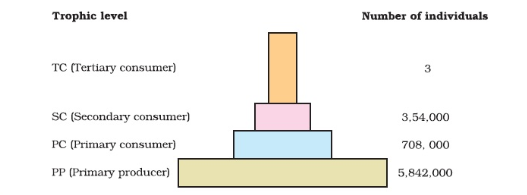
➔ Pyramid of numbers in a grassland ecosystem:
✔ Only three top-carnivores are supported in an ecosystem based on production of nearly 6 millions plants.
➔ Pyramid of biomass:
✔ Sharp decrease in biomass at higher trophic levels.

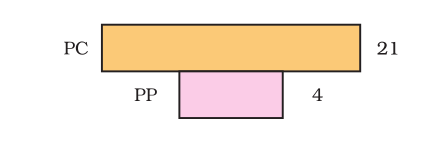
➔ Inverted pyramid of biomass:
✔ Small standing crop of phytoplankton supports a large standing crop of zooplankton.
✔ E.g.- Number of insects feeding on a big tree.
o Pyramid of biomass in sea - biomass of fishes far exceeds that of phytoplankton.
➔ An ideal pyramid of energy:
✔ Only 1% of the energy in the sunlight available to them into NPP
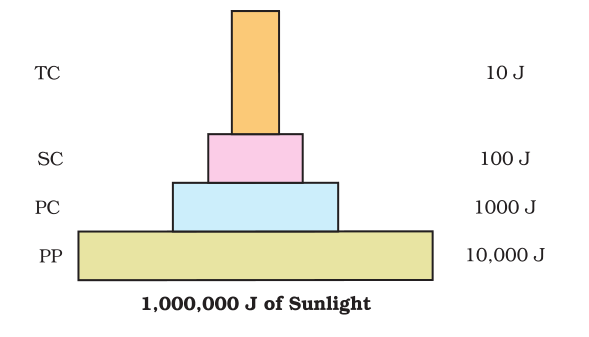
✔ Pyramid of energy is always upright, can never be inverted-
o Because when energy flows from a particular trophic level to the next trophic level, some energy is always lost as heat at each step.
✔ A trophic level represents a functional level and not a single species as such. Also, a single species may become a part of more than one trophic level in the same ecosystem at the same time depending upon the role it plays in the ecosystem.
➔ Limitations of ecological pyramids:
o The ecological pyramids do not take into account the same species belonging to more than one trophic level.
o It assumes a simple food chain that almost never exists in nature. It does not explain food webs.
o Saprophytes are not given a place in ecological pyramids even though they play a vital role in the ecosystem.
➢ ECOLOGICAL SUCCESSION
✔ The gradual and fairly predictable change in the species composition of a given area.
✔ The composition and structure of a community constantly change in response to the changing environmental conditions.
✔ These changes lead finally to a climax community.
✔ Climax community: The community that is in near equilibrium with the environment.
✔ Sere: The entire sequence of communities that successively change in a given area.
✔ Seral stages / seralcommunities : The individual transitional communities.
✔ Primary succession: The succession that happens in areas where no life forms ever existed as in bare rocks, cool lava, etc.
o It takes hundreds to thousands of years as developing soil on bare rocks is a slow process.
✔ Secondary succession: The succession that happens in areas which have lost all life forms due to destructions and floods, etc.
o Since some soil or sediment is present, succession is faster than primary succession.
➔ Successions of plants
✔ Hydrarch succession: It takes place in wetter areas and the successional series progress from hydric to the mesic conditions.
✔ Xerarch succession: It takes place in dry areas and the series progress from xeric to mesic conditions.
✔ Both hydrarch and xerarch succession lead to medium water conditions (mesic) – neither too dry (xeric) nor too wet (hydric).
✔ Pioneer species: The first species that invade a bare area.
Primary succession on rocks:
o Lichens are the pioneer species.
o They secrete acids to dissolve rock, helping in weathering and soil formation.
o This later helps the plants like bryophytes to grow there.
o The bryophytes with time gets succeeded by bigger plants.
o After several more stages, ultimately a stable climax forest community is formed.
o The xerophytic habitat gets converted into a mesophytic one.
✔ The climax community remains stable as long as the environment remains unchanged.
Primary succession in water :
o Pioneer species are the small phytoplanktons.
o They are replaced with time by rooted-submerged plants.
o Rooted-floating angiosperms are replaced by free-floating plants
o The free-floating plants are replaced by reed-swamp, marsh-meadow, scrub and finally the trees.
o The climax community here is forest.
o With time the water body is converted into land.
Secondary Succession:
✔ The pioneer species depends on the following factors:
o Condition of the soil
o Availability of water
o The environment
o The seeds or other propagules present
✔ As the soil is present at the beginning the climax community is reached much quickly.
➢ NUTRIENT CYCLING
✔ The amount of nutrients present in the soil at a given time is known as the standing state.
✔ Nutrients are never lost from the ecosystem. They are only recycled from one state to another.
✔ The movement of nutrients through the various components of the ecosystem is called nutrient cycling or biogeochemical cycles. They are of two types:
o Gaseous Reservoirs for these types of cycles exist in the atmosphere.
o Sedimentary − Reservoir for these types of cycles exist in the earth’s crust.
➔ Ecosystem-Carbon Cycle
✔ About 49% of the dry weight of living organisms is made up of carbon.
✔ The ocean reserves and fossil fuels regulate the amount of CO2 in the atmosphere.
✔ Plants absorb CO2 from the atmosphere for photosynthesis, of which a certain amount is released back through respiratory activities.
✔ A major amount of CO2 is contributed by the decomposers who contribute to the CO2 pool by processing dead and decaying matter.
✔ The amount of CO2 in the atmosphere has been increased considerably by human activities such as burning of fossil fuels, deforestation.
➔ Ecosystem-Phosphorous Cycle
✔ Phosphorus is a major constituent of biological membranes, nucleic acids and cellular energy transfer systems.
✔ Many animals also need large quantities of this element to make shells, bones and teeth.
✔ The natural reservoir of phosphorus is rock, which contains phosphorus in the form of phosphates.
✔ When rocks are weathered, some of the phosphate gets dissolved in the soil solution and is absorbed by plants.
✔ The consumers get their phosphorus from the plants.
✔ Phosphorus returns back to the soil by the action of phosphate- solubilising bacteria on dead organisms.
 |
➢ Ecosystem Services
✔ The products of ecosystem processes are named as ecosystem services:
o healthy forest ecosystems purify air and water, mitigate droughts and floods, cycle nutrients, generate fertile soils, provide wildlife habitat, maintain biodiversity, pollinate crops, etc.
✔ Robert Constanza and his colleagues tried to put price tags on nature’s life-support services.
✔ The Average price tag was calculated to be of US $ 33 trillion a year on these fundamental ecosystems services.
**************************
****************************************
Download PDF Notes for Ecosystem - Class-XII.


0 Comments